Ask a marketer and a salesperson to describe what they do, and you'll get two very different answers. One talks about campaigns, content calendars, and engagement. The other talks about calls, proposals, and closing. On paper, it looks like two departments with two different skill sets, occasionally forced to work together.
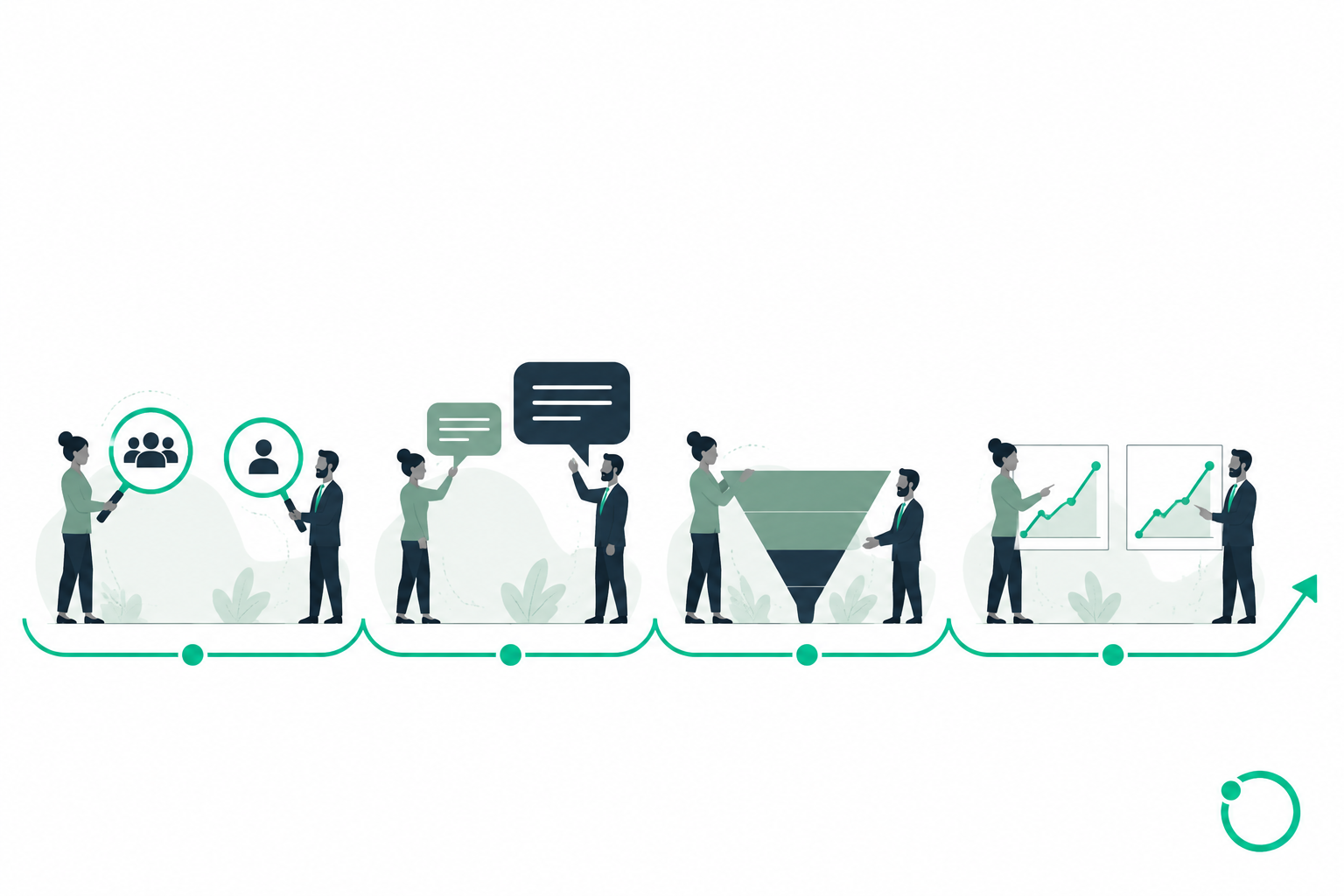
Watch what they actually do all day, and a different picture shows up. Underneath the different job titles, marketing and sales are running the same four moves — just at different scale, and at a different stage of the same journey. Marketing starts the conversation with a crowd. Sales finishes it with an individual. Everything in between is more alike than most businesses ever stop to notice.
Here's what that overlap actually looks like.
Before a single ad goes live, marketing has already asked a research question: who is this for, what do they care about, what problem is keeping them up at night. Before a single sales call happens, a rep is asking the exact same question about one specific company: what do they need, what's their budget, what's standing between them and a "yes."
It's the same instinct, applied at two different zoom levels. Marketing researches a crowd. Sales researches an individual. When the two teams treat this as separate work instead of the same work at two scales, they end up duplicating effort — sales rebuilding a picture of the customer that marketing had already put together, marketing guessing at objections that sales hears every single day on calls.
The fix isn't complicated: the audience insight marketing gathers should become the opening line sales actually uses, instead of two teams learning the same thing twice, on two different timelines.
An ad headline and a sales pitch are doing the exact same job: giving someone a reason to care, fast. One earns attention in three seconds on a scroll. The other earns a decision across a call or a table. Different length, different setting — but built from the same structure every time: hook, problem, why us, what to do next.
Marketing writes the ad copy and the promo caption that has to stop someone mid-scroll. Sales writes the follow-up email and the pitch that has to move someone toward a decision. When the two teams compare notes on what's actually landing — which lines get replies, which offers trigger objections, which words make someone lean in — both get sharper. Marketing starts writing ads that pre-answer the objections sales keeps hearing. Sales starts pitching with the same language that already made someone click in the first place.
Marketing moves a stranger through awareness, then interest, then consideration — using content, ads, and promos to nudge someone one step closer at a time. Sales moves that same person through a first call, a proposal, and a close — using conversation and follow-up to do the exact same thing, just further down the road.
It's the same shape of funnel, run by two different teams who rarely compare where their piece starts and ends. That's the most common gap we see: two pipelines running side by side, each team optimizing their own stage, neither one looking at where their funnel hands off to the other's. A step that's working well in marketing should be informing the next step in sales — not running in parallel, never meeting.
Marketing watches click-through rates, engagement, and conversions. Sales watches call rates, meetings booked, and deals closed. Different dashboards, same underlying question, asked every single day: is this working, and what do I change if it isn't?
When these two sets of numbers stay in separate spreadsheets, both teams end up optimizing in isolation — marketing chasing a metric that looks good but doesn't always turn into revenue, sales working leads without knowing which ones came from the campaigns that were actually converting. Put the numbers side by side, and the picture gets a lot clearer, a lot faster.
None of this means marketing and sales should merge into one team, or that the skills involved are identical down to the last detail. A great ad and a great pitch still require different instincts to execute well. What it means is that the instinct underneath both jobs — research, persuade, move someone forward, track what's working — is the same instinct, applied at two different distances from the customer.
Businesses that grow steadily tend to be the ones where marketing and sales already know this, even if no one's said it out loud. The audience insight doesn't stay stuck in a slide deck. The language that works in an ad shows up in a pitch. The funnel is treated as one continuous line, not two separate ones. And the numbers get reviewed together, not in two different meetings that never talk to each other.
At Ouranos Technologies Limited, this is the lens we bring to every marketing-and-sales engagement: find the four moves each team is already making on their own, and connect them — so neither team is starting from zero, and both are pulling toward the same number.